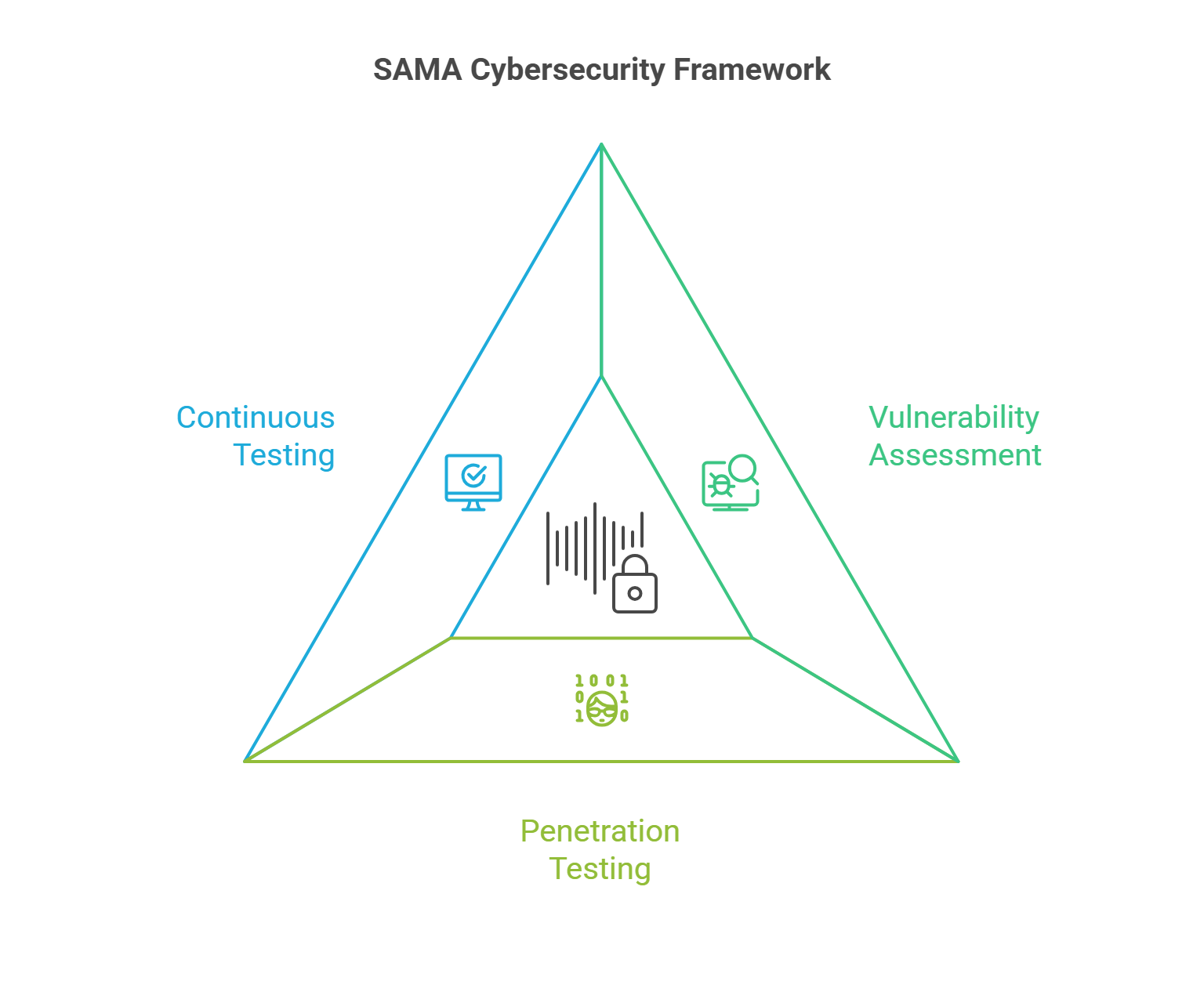
Why the SAMA Cybersecurity Framework is Relevant for Saudi Arabian Businesses

The Saudi Arabian Monetary Authority (SAMA) Cybersecurity Framework is far more than a regulatory checklist—it represents a fundamental shift in how financial institutions in the Kingdom must approach digital security. As Saudi Arabia accelerates its Vision 2030 digital transformation, the framework has become essential for protecting the financial sector, building trust, and enabling innovation.
In this guide, we'll explore why the SAMA Cybersecurity Framework matters, who must comply, key requirements, and how your organization can benefit from compliance.
What is the SAMA Cybersecurity Framework?
The SAMA Cybersecurity Framework is a comprehensive set of cybersecurity controls and guidelines issued by the Saudi Arabian Monetary Authority. It is designed to enhance the cybersecurity posture of financial institutions operating in Saudi Arabia by establishing minimum security requirements and best practices.
The framework covers four interconnected domains that go far beyond technical controls:
| Domain | Focus Area |
|---|---|
| Cybersecurity Governance | Board-level accountability, clear roles, strategy alignment |
| Risk Management | Identifying, assessing, and mitigating cyber threats |
| Cybersecurity Operations | Access controls, monitoring, incident response |
| Third-Party Security | Vendor risk management and partner security |
A Legal Requirement, Not an Option
The SAMA Cybersecurity Framework is mandatory for a wide range of financial institutions operating in Saudi Arabia. This includes:
- All banks operating in the Kingdom
- Insurance and reinsurance companies
- Financing companies
- Credit bureaus
- Financial market infrastructures (payment systems, clearing houses)
- Fintech firms and digital banks
Non-compliance carries serious consequences. Financial fines can reach SAR 5 million per breach, with additional penalties including operational restrictions, service suspensions, and even license revocation in severe cases. In 2025 alone, SAMA levied significant penalties across numerous violations.
Why SAMA Compliance Matters in 2026
1. Legal Requirement & Regulatory Compliance
Compliance with the SAMA Cybersecurity Framework is not optional—it is a legal obligation. The framework establishes mandatory cybersecurity controls that financial institutions must implement to operate legally in Saudi Arabia. Failure to comply can result in severe financial penalties, operational restrictions, and reputational damage.
2. Protection Against Cyber Threats
Saudi Arabia's financial sector faces unprecedented cybersecurity challenges. As digital banking, mobile payments, and fintech innovations expand, the potential attack surface grows significantly. The framework ensures that financial institutions can effectively identify and address cyber risks by establishing a common approach across the sector.
3. Supporting Vision 2030 Digital Transformation
The framework enables secure innovation. As institutions adopt new technologies like open banking, AI-driven experiences, and cloud-first models, they must do so without compromising security. The framework provides structured guidance on safely integrating new technologies while managing associated risks—ensuring digital transformation initiatives don't create vulnerabilities.
4. Building Customer Trust
Customer trust is the currency of the digital economy. By demonstrating SAMA compliance, financial institutions signal their commitment to protecting sensitive customer data and operations. This trust translates into customer loyalty, competitive advantage, and long-term business sustainability.
5. Competitive Advantage
In a tightly regulated environment, being SAMA compliant can differentiate your business. It shows that your organization is proactive and trustworthy—ready to handle cybersecurity challenges before threats emerge. Compliance also attracts investors and fosters a positive brand image.
Key SAMA Cybersecurity Framework Requirements
The framework establishes comprehensive security controls across multiple domains:
1. Cybersecurity Governance
Organizations must establish clear governance structures with board-level oversight. This includes defining roles and responsibilities, developing security strategies, and ensuring accountability at the highest levels.
2. Risk Management
Financial institutions must implement robust risk management processes to identify, assess, and mitigate cybersecurity risks. This includes regular risk assessments, vulnerability management, and continuous monitoring.
3. Security Operations
Organizations must deploy technical controls including access control, network security, encryption, logging and monitoring, and incident response capabilities.
4. Third-Party Risk Management
With increasing reliance on vendors and partners, organizations must implement controls to manage third-party security risks. This includes vendor due diligence, contract requirements, and ongoing monitoring.
5. Incident Response and Business Continuity
Organizations must have comprehensive incident response plans and business continuity procedures to ensure rapid recovery from cyber incidents and maintain critical operations.
6. Awareness and Training
Regular security awareness training for all employees is mandatory to build a security-conscious culture and reduce human error risks.
SAMA Maturity Model: Progressive Security Enhancement
The SAMA Cybersecurity Framework uses a six-level maturity model (Level 0 to Level 5) that allows institutions to progressively enhance their cybersecurity posture:
| Level | Description |
|---|---|
| Level 0 | Non-existent - No formal cybersecurity awareness or practices |
| Level 1 | Initial - Ad-hoc approach with limited controls |
| Level 2 | Repeatable - Basic processes and controls established |
| Level 3 | Defined - Formal processes documented and implemented |
| Level 4 | Managed - Proactive monitoring and continuous improvement |
| Level 5 | Optimized - Advanced security capabilities and innovation |
Most organizations are expected to achieve Level 3 (Defined) or higher to demonstrate adequate cybersecurity maturity.
Benefits of SAMA Compliance for Your Business
✅ Enhanced Cybersecurity Posture
Implementing SAMA controls strengthens your organization's defenses against cyber threats, reducing the risk of data breaches and financial losses.
✅ Regulatory Compliance
Avoid legal consequences, financial penalties, and operational restrictions by meeting mandatory regulatory requirements.
✅ Customer Trust and Loyalty
Show customers and stakeholders your commitment to protecting their data, enhancing brand reputation and loyalty.
✅ Competitive Advantage
Stand out in the market by demonstrating proactive security practices and regulatory compliance.
✅ Business Resilience
Ensure business continuity with robust incident response and disaster recovery capabilities.
✅ Secure Innovation
Enable digital transformation initiatives with confidence, knowing security is integrated by design.
How Asgaurda Can Help with SAMA Compliance
At Asgaurda, we specialize in helping financial institutions in Saudi Arabia achieve and maintain SAMA Cybersecurity Framework compliance. Our services include:
- Gap Assessment: Evaluate your current security posture against SAMA requirements
- Risk Assessment: Identify threats, vulnerabilities, and compliance gaps
- Policy Development: Create security policies and procedures aligned with SAMA standards
- Security Implementation: Deploy technical, operational, and managerial security controls
- Internal Audit Support: Conduct internal audits and assist during external compliance audits
- Training & Awareness: Empower your teams with SAMA compliance knowledge
- Continuous Monitoring: Maintain compliance with ongoing monitoring and reporting
- Maturity Improvement: Progressively enhance your cybersecurity maturity level
Get a Quote for SAMA Compliance Services
Frequently Asked Questions (FAQs)
Who needs to comply with the SAMA Cybersecurity Framework?
The framework is mandatory for all banks, insurance companies, financing companies, credit bureaus, financial market infrastructures, and fintech firms operating in Saudi Arabia.
What are the penalties for non-compliance?
Fines can reach SAR 5 million per breach, with additional penalties including operational restrictions, service suspensions, and license revocation in severe cases.
How long does it take to achieve SAMA compliance?
The timeline depends on your organization's current security posture and maturity. Typically, achieving full compliance can take several months, involving gap assessments, risk mitigation, policy development, and security control implementation.
How does SAMA compare to other frameworks like ISO 27001?
While SAMA incorporates many practices from ISO 27001 and other global standards, it is specifically tailored to the Saudi Arabian financial sector and includes unique requirements aligned with local regulations and threats.
What is the SAMA maturity model?
The maturity model has six levels (0-5) that allow organizations to progressively enhance their cybersecurity posture. Level 3 (Defined) is typically the minimum expected level for compliance.
How can Asgaurda help with SAMA compliance?
Asgaurda offers end-to-end SAMA compliance services including gap assessments, policy development, security implementation, audit support, and training. Contact us to learn more.
Conclusion
The SAMA Cybersecurity Framework is essential for financial institutions operating in Saudi Arabia. It represents a legal requirement, a security imperative, and a strategic enabler for Vision 2030 digital transformation.
By achieving SAMA compliance, organizations can:
- Protect against cyber threats and financial losses
- Avoid regulatory penalties and legal consequences
- Build customer trust and competitive advantage
- Enable secure innovation and digital growth
- Demonstrate commitment to national security priorities
Don't wait for a breach or regulatory action to prioritize cybersecurity. Take proactive steps today to protect your organization and contribute to a secure digital future for Saudi Arabia.
Ready to achieve SAMA compliance for your organization?